We use cookies to make your experience better. To comply with the new e-Privacy directive, we need to ask for your consent to set the cookies. Learn more.
- Kris Coombes
- News
- 8 Mar 2016

We've seen some ingenious kitchen technology already in 2016, but what will we see in the future?
The digital revolution is in full effect and shows no signs of stopping until it has embedded itself in every possible nook and cranny of life that it possibly can. Kitchen technology is no exception to this rule, though it has progressed slower than technological development in other areas of consumer and commercial needs.
2016 however could be set to be the year of the kitchen, so here are our predicted kitchen technology trends for the future.
1) The “Smart Fridge” will be a big deal
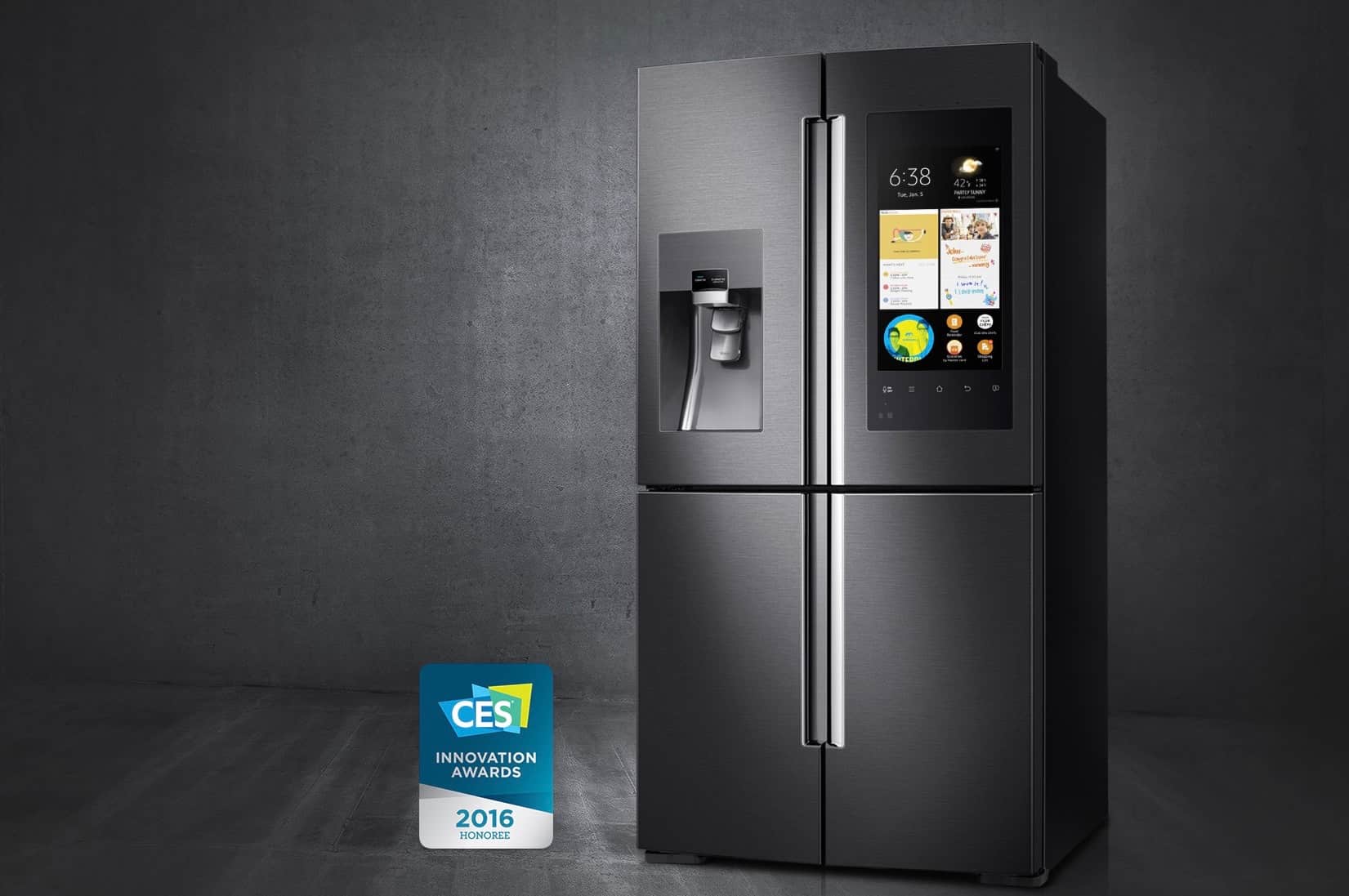
At CES 2016 in January, both Samsung and LG unveiled the next generation of fridge. Let’s first look at LG’s monstrosity.
At the epicentre of the fridge revolution is the addition of a panel on the right-hand door, which in LG’s case functions solely as a window to your chilled goods. You can now check your milk without losing the valuable cool temperature that comes with opening your fridge. All seems a bit pointless, but the little differences go a long way. The panel is made out of darkened glass which reacts when you knock on it, clearing the window for your viewing pleasure.
Additionally, a sensor-projector combination at the base of the door detects when you are nearby and gently opens the door on your behalf, because sometimes you just cannot be bothered. A high-tech but still largely simple fridge, it still packs all the basic features people look for in a fridge such as double doors and massive capacity.
If you really have a lot of disposable income to… dispose of, Samsung’s fridge of the future could be perfect for you. How? It’s a fridge come tablet come smartphone.
This animal does things a refrigerator simply has no right to do. Alongside its usual duties of maintaining a safe temperature for your yogurt and cheese, it also boasts connectivity to the internet and every other smart appliance in your home, acting as a central hub to control your heating from when you aren’t around and even having the ability to turn lights on and off. Kitchen technology has never been more sophisticated.
Its main selling point is its grocery ordering app, which makes it super simple to stock up on food. A litany of cameras inside the fridge will also allow you to physically look at the contents of it to see if you’ve run out of anything while you’re out, provided your smartphone is connected to it.
It costs $5000 and, unsurprisingly, Samsung aren’t expecting it to be a major commercial success. In fact, they see this as more of a prototype project to see what consumers will actually buy when it comes to fridges. There’s also the issue of longevity; who knows what fridges will look like in 5 years? And what other smart devices will be tattooed with a touchscreen? Perhaps more importantly, will this technology be applicable to the commercial kitchen?
2) The birth of the all-in-one Robochef
Kickstarter and other crowdfunding sites have given rise to some truly wonderful projects. One project, OneCook, has raised $103,206 and counting, and there’s a good reason why.
So you’ve just come home from a long shift at work. You really don’t want to cook, but everything quick and easy is less healthy than a cooked meal. Current “robochef” technology is far too expensive to be consumer viable, so OneCook aims to bring a solution to an age old problem to the home.
Having been tested by professional chefs, it can cook over 50% of home cooking recipes to the same standard as a human (or better!). It can stir fry, braise, boil, steam, stir fry, automatically add ingredients set on a timer and even control fumes and vapour.
Similar “robochef” products include the Gourmia GKM9000 which made its debut at the International Home + Housewares Show last month. While not an out and out cooking machine like the OneCook, this does include different but similarly cook functions such as pureeing, kneading and whipping, which makes it superb for baking and pastries.
Could these ever replace a professional chef? Almost certainly not, but these pieces of kitchen technology could become part of the furniture in households worldwide.
3) Your shopping lists will be highly optimised
Smarter have designed three simple but effective products designed to streamline the creation and management of shopping lists and generally make your kitchen more efficient.
The first of these is the Fridge Cam. If you don’t want to spend $5000 on Samsung’s super-fridge, this much cheaper alternative takes photos every time you check your fridge, allowing you to check on your stock while you’re out, or if you’re lazy, at home!
The second is the Mat; placing your jars on this Wi-Fi connected device will allow you to keep track of the contents of these jars to see if you need a top-up
The more unrelated third product is for the hard of hearing; the Detect device will send an alert to your phone when it hears certain sounds in the kitchen, such as a timer, microwave beep or fire alarm.
4) Get healthy with sensory technology
Scan your food, manage your health. That’s the message Consumer Physics are sending out with their new Diet Sensor.
In restaurant settings, there has been pressure to inform customers of exactly what they’re eating when they order a meal. Nuggets of information such as calories and fat content are becoming more prominent on menus as a result.
If you want to mine even deeper into the nutritional content of your meals, the Diet Sensor is a future must-have. It works by sending infrared beams to reflect information on the composition of the food or drink back to the device. It will then produce a profile that tells you how much you should eat for the meal, with information on calorie, carbohydrate, fat and protein content available.
Unfortunately, while this kitchen gadget is fascinating and incredibly innovative, it can only read information from the surface layer of the food or drink, so if you wanted to scan a multi-layered sundae or a pie for instance, you would only get information on the layer you scan.
Nevertheless, expect sensory diet technology to make major wave sin 2016.
5) Better renewable energy-powered cooking
Every year, CES name several Innovation Awards Honorees to spotlight major steps forward in technology. This year, GoSun were honoured as a result of their innovative new solar powered grill.
It’s not what you think, however.
Rather than using solar panels, it actually directs sunlight towards a centrally mounted tube, which contains a solar evacuated tube that can absorb in surplus of 80% of reflected sunlight. The design allows it to receive sunlight without it having to be rotated, and can heat the central cylinder up to 550 degrees. It can even function in winter when there’s cloud cover.
The cost ranges from $279-$749 (around £200-£530), and the high end model can harvest any surplus energy via USB connection to charge electrical appliances. They offer a free recipe book on their website to get you started. This could well be the first of a new generation of efficient renewable cooking gadgets.
6) Even your whisk will know more than you
The most commercial kitchen-applicable gadgets to emerge from CES 2016 were iCuisine’s veritable smorgasbord or sensor-clad kitchen tech, including, but far from limited to, a mixing bowl, sauce shaker, whisk, moulds and measuring spoons, everything is kitted up with sensory technology with a variety of functions.
For example, the whisk can measure temperature and can be used in conjunction with the frying pan, which contains a meat thermometer in the handle. The chopping board is capable of weighing items while you chop them, while the measuring spoons have quantity and temperature measuring functions. The food containers are probably the most useful of all, as they can record expiry date and general food content information.
In addition to the plethora of utensils you get, iCuisine also grant you access to an incredible database containing over 70000 ingredients to help you plan meals and eat healthily. The iCuisine app allows you to create shopping lists, track expiry dates and interact with other people in the community by sharing recipes and experiments.
The technology on display in these gadgets will definitely make life easier for home cooks and could even help streamline the cooking process for professionals.
Bonus: People will stop cleaning their kitchens
This is here not because we will necessarily observe the rise of truly effective cleaning technology, but more because we really, REALLY don’t like cleaning. Grillbot has been around for a few years now, but has never really set the world alight, and it continues to be a solid if unspectacular alternative to the humble grill brush, but outside of that, everything has been wide of the mark.
Generally, cleaning robots simply cannot match the job of a human when it comes to cleaning; their natural inflexibility means they can’t reach places we can, and they also can’t apply as much force to stubborn grime as we can.
Price is also an issue. Why would you spend £100 on a robot that won’t do a proper job when you could buy a brush for a quid and get stuck in? Until we see kitchen technology as sensitive as a human touch, we probably won’t see a good cleaning robot… but we really hope so!
Related Posts





Recent Posts
1

Kit your Kitchen: 20% off chef uniforms
26 Jun 2025
2

Uniform Workwear Trends 2025
27 Feb 2025
3


5

 RSS Feed